DryLab® Overview

Built for Scientists. Trusted across the industry.

Turn experimental data into scientifically grounded visual models, and develop robust, inspection-ready HPLC methods faster and easier.

In a nutshell.

Months of lab work in minutes. Predict >1 million chromatograms accurately from only 12 input runs in seconds.

99% accuracy on predicted retention times. Top precision for faster time to market.

3D design spaces reveal what works. Robust methods across all your conditions.

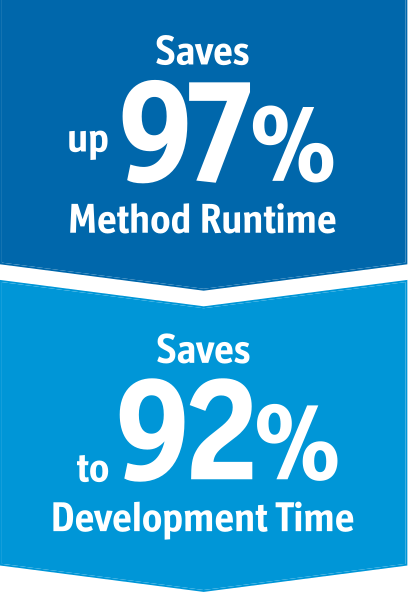
Slash method runtimes by up to 97% and cut method development time from months to as little as one week.
Find the best work ranges for your separation. Accommodate for the requirements of your ATP: vary pH, temperature, flow rate, and more. All at once.

Assess robustness, no revalidation. Learn which parameters count. Control what matters.

QC-proof documentation that justifies every choice. Built-in knowledge management for the whole team.

Automate sample sets with one click. CDS integration eliminates manual transfer and human error.

DryLab® is the revolutionary HPLC method development and optimization software developed by Lloyd Snyder and his team of fellow researchers.

DryLab® predicts chromatograms under a much wider range of experimental conditions than would ever be possible in the laboratory. With DryLab®, you can quickly and easily determine exactly how your separation changes as you simultaneously vary multiple method parameters, such as pH, temperature, buffer concentration, and many more. Anybody developing HPLC methods who wishes to optimize complex samples and to economize resources spent developing and running methods will benefit from the many advantages offered by DryLab®.

Everything you need. All in one place.

Gradient Editor

Fine-tune complex gradients with interactive control.

3D Resolution Cube

Explore chromatographic behavior in multidimensional space.

Design Space Navigation

Visualize robustness across conditions to meet ICH Q8/Q9/Q14 Standards.

Peak Tracking & Retention Time Prediction

Achieve over 99% accuracy with minimal experimental runs.

Advanced Reporting & Exporting

Ready-to-submit documents and visuals.

Compatible With Your Lab Ecosystem

Easy import/export of method data and experimental results with Agilent, Waters, Thermo, and Shimadzu

Robustness Mapping

Know where your method will break, before it does.

QbD & DoE Integration

Built-in design of experiments to meet compliance needs.

Step into ICHQ14 with the systematic DryLab® Analytical Design Space Modeling workflow.

Book a Demo
DryLab® software showing analytical target profile and input experiment setupDryLab® software showing matched peak tracking and peak table generationDryLab® software showing a multi-dimensional resolution model and working point selectionDryLab® software showing additional method parameter evaluationDryLab® software showing robustness threshold testing across separation parametersDryLab® software showing a generated GMP-compliant Knowledge Management report

Comparing DryLab® vs. other available packages

FeatureDryLab®Other SoftwaresWhat it means
Predictive Accuracy>99% accuracy in predicting retention times and resolution from just a few runs.Often relies on statistical or AI-based pattern recognition with variable accuracy.Trust your model. DryLab® reveals what will happen, not just what might — minimizing lab work, wasted runs, and risk.
Scientific FoundationBased on true chromatographic theory and physico-chemical modeling.Primarily statistical, DOE, or AI-driven; often a “black box.”Gain understanding, not just numbers — know why your separation behaves the way it does.
Experiment EfficiencyRequires only 2–12 input experiments to explore millions of possibilities.Typically needs larger DOE matrices or automated run cycles.Achieve deep insight with minimal bench work — save solvents, time, and resources.
Visualization & Design SpaceIntuitive 3D models and Gradient Editor visualize resolution landscapes in real time.Limited or basic 2D DOE plots.See your chromatographic world in full color — understand complex interactions instantly.
Peak Tracking & Separation ControlMechanistic peak tracking handles co-elution, shifting, and complex separations.AI or algorithmic matching may miss subtle retention shifts.Master even the most difficult separations — confidently separate what others can’t.
Regulatory & QbD AlignmentBuilt for ICH Q8, Q9, Q14, QbD, and GMP — produces fully compliant reports for submission.Many tools support QbD but are often incomplete or require manual documentation.Stay audit-ready with automated GMP reports that justify every parameter choice.
Robustness & Method TransferModels up to six parameters for robustness testing and transfer across instruments.Often limited to screening or statistical robustness assessment.Transfer methods seamlessly — no guesswork, no surprises in validation.
Knowledge Sharing & ReportingGenerates comprehensive Knowledge Management reports and clear documentation.Often exports data; documentation requires manual effort.Turn method development into organizational knowledge — capture, share, and justify every insight.
Scientific Credibility, Rigor and ValidationSupported by decades of peer-reviewed publications and regulatory adoption.Few peer-reviewed validations; mostly vendor case studies.Trust built on science. DryLab® stands on proven ground — used by leading pharma, CROs, and academia.
Human Support & ExpertiseBacked by direct consulting, workshops, and decades of chromatographic expertise.Primarily software support or sales-led guidance.Learn from scientists, not sales reps — every interaction is a masterclass in method development.

Retention phenomena of reversed-phase chromatography (RPC) are described in many ways by different authors.

One of the groups attempting to understand the fundamentals of RPC were the developers of the DryLab® software, LC Resources Inc. in the United States, under the leadership of Lloyd Snyder, John Dolan, Tom Jupille, and Imre Molnár in Berlin, Germany.

DryLab® History

DryLab® draws on the philosophy described in the three most famous Solvophobic Theory papersI,II,IIIof Csaba Horváth, which were developed in the years 1975-1977 at Yale University.

The increasing demand for Quality by Design (QbD) in analytical science is a logical consequence of the often-chaotic method development, that results from a trial and error approach, during which stumbling over new or disappearing peaks in the UHPLC validation process is a common pitfall. To ensure a higher standard of method quality, in 2002 the ICH and FDA started demanding solid and scientific work using Design of Experiments (DoE).

Molnár-Institute has been promoting this type of approach for over 27 years by contributing to the development of DryLab® software through cooperation with LC Resources, under the leadership of Lloyd R. Snyder. Using DryLab®, the systematic and accurate preparation of experiments was initiated, achieving useful and reproducible results. Better peak tracking in DryLab® ensured safe and precise data entry before the model was built.

Designed by UHPLC experts, DryLab®4 offers chromatographers’ unprecedented insight into how a substance can best be separated, and efficiently supports the success of their chromatographic work. DryLab® is the world standard for chromatography modeling in both: method development and training applications.

The following time schedule shows the long and well-documented development history of DryLab® — from the very beginning in 1986 to the essential UHPLC method development tool we have today.

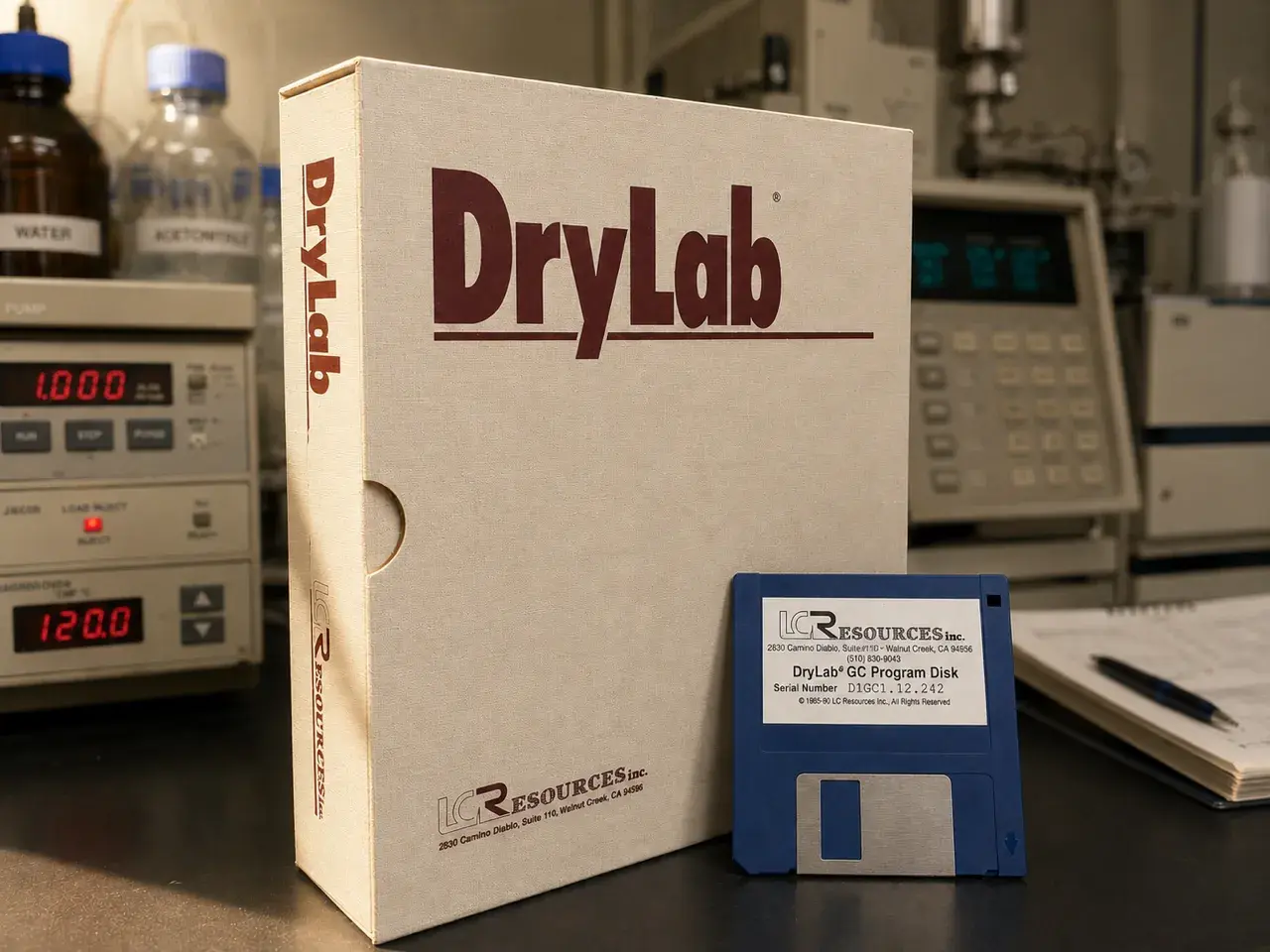
The original boxed DryLab® GC software with its LC Resources program disk, beside period HPLC instrumentation
The original DryLab® GC release from LC Resources — boxed software and program disk, © 1985–90

1986

DryLab® LC Simulator

The world’s first HPLC simulation software, originally programmed in BASIC for MS-DOS. Developed by the LC-Resources team, it pioneered computer-aided method development by modeling critical resolution (Rs,crit) against key parameters like %B, tG, T, pH, tC, cIPR and pH. Long before graphical displays, it famously plotted resolution curves and separation windows right on the terminal using MS-DOS asterisks (*)—cutting benchtime by up to 90%.

1987

DryLab® I

Featuring upgraded DOS graphics, DryLab I expanded simulation capabilities to normal-phase chromatography. It introduced column plate number corrections—enabling chromatographers to adjust models for non-ideal scenarios that impact bandwidths.

1988

DryLab® G

Introducing predictive modeling for gradient elution, DryLab G debuted the Gradient Editor feature to easily design, adjust, and multi-segment complex gradient profiles. It also enabled instant recalculation for column hardware changes—such as length, internal diameter, and particle size—allowing rapid optimization of run time, peak capacity, and solvent usage.

1990

DryLab® I/mp

Completely reprogrammed in C for the Windows® 1.0 operating system, DryLab I/mp introduced a wholly graphical user interface with full mouse control. This release expanded existing simulations with restricted multi-parameter capabilities, allowing chromatographers to evaluate relevant parameter effects step-by-step to identify optimal separation conditions.

1998

DryLab® for Windows

The first version featuring true two-dimensional (2D) modeling capabilities, introducing simultaneous optimization of two separation parameters (such as %B–T, tG–T, %B–CIPR or pH–cbuffer). This landmark release allowed chromatographers to explore multi-variable parameter interactions on a single, comprehensive resolution surface (heat-map), mapping out robust operational regions while dramatically accelerating method development turnaround.

2000

DryLab® 2000 and PeakMatch®

Upgraded for Windows 3.1 and later Windows XP, this was the first version released in C++. The Peak Match versions introduced peak-tracking, streamlining the necessary manual alignment of peaks across different input chromatograms to reduce errors and significantly boost laboratory productivity.

2006

DryLab® Acquisition

DryLab was acquired by the Molnár-Institute, moving software development to Berlin, Germany. Led by Dr. Imre Molnár, this transition focused future development on multi-dimensional modeling and aligning software workflows with modern Quality by Design (QbD) standards.

2009

DryLab® 3.9 and DryLab® 2010

Introduced "3D Cubes"—three-dimensional resolution mapping enabling the simultaneous optimization of 3 critical parameters (such as tG, T, tC and pH). This major advance allowed chromatographers to visualize complex multi-variable interactions within an interactive 3D Design Space, establishing a comprehensive, Quality by Design (QbD)-compliant approach to method development.

2012

DryLab® 4

The first version re-engineered in C#, featuring a modern, user-friendly window management system and an upgraded 3D Cube engine. Compatible from Windows® XP through Windows® 11, this release delivered enhanced graphics rendering, smooth multi-window navigation, and long-term OS stability for enterprise laboratory environments.

2013

Robustness and Knowledge Management Modules

Introduced the Robustness Module for in silico quantification of prospective method performance, allowing chromatographers to evaluate method stability against experimental variability before routine execution. This update also added a dedicated GMP-compliant reporting module, enabling automated generation of audit-ready development reports to streamline regulatory documentation and method transfer.

2017

Column Comparison Module

Launched a systematic comparison tool allowing side-by-side comparison of 3D Design Spaces across different stationary phases. This milestone replaced traditional column characterization methods with a modern, Quality by Design (QbD)-compliant methodology—enabling chromatographers to select equivalent or alternative columns based on true, multi-parameter separation behavior.

2019

Waters Empower Automation Module

Developed a new software connectivity module for Waters Empower CDS, enabling automated dataset creation and retrieval across software layers. Featuring one-click data transfers, this seamless integration eliminated manual transcription errors, streamlined experimental workflows, and significantly improved overall laboratory productivity.

2024

Design Space Comparison Module

Replacing the earlier Column Comparison Module, the new DSC enables direct 2D and 3D comparisons of entire separation spaces. This advanced module allows chromatographers to tackle frequent chromatographic challenges—such as column interchangeability, batch-to-batch stationary phase reproducibility, and buffer replacements—while seamlessly assisting method transfer between different instruments and laboratories.

2026

New Automation Module

Featuring a freshly polished, modern user interface, the new Automation Module unifies connectivity for both Waters Empower and Agilent OpenLab CDS platforms. This streamlined integration provides a cohesive workflow for automated dataset creation and multi-layer data retrieval.

Used by thousands around the globe.

I have been using DryLab since my PhD studies and continue to rely on it in my current role at Bayer AG. DryLab allows us to efficiently predict retention behavior and assess the impact of changing compound mixtures, significantly reducing experimental effort during method development. Its strong scientific foundation, based on established chromatographic models, delivers reliable results, while the software continues to evolve with valuable new capabilities. Beyond its practical benefits, DryLab is also an excellent learning tool, backed by a highly responsive and knowledgeable support team.

Ryan Karongo, PhD

Ryan Karongo, PhD

Senior Scientist, Oligonucleotide and Peptide Analytics, Bayer AG

I've used DryLab for 10 years as an integral part of my approach to HPLC method development in pharmaceutical development, from early-stage drug candidates through late-stage programs. I have found it particularly valuable for challenging separations involving large, structurally complex small molecules with complicated impurity profiles, including methods where as many as 30 individual peaks needed to be separated. DryLab enables me to explore a much larger chromatographic design space than would be practical experimentally and, importantly, to better understand the factors driving selectivity between closely eluting components. For complex impurity profiles, this ability to model and visualize how changes in chromatographic conditions influence the entire separation can be extremely powerful. That capability is valuable throughout the stages of pharmaceutical development from rapidly identifying effective separation conditions for early-stage candidates to developing increasingly robust and well-understood methods as programs advance. DryLab helps me make more informed development decisions, reduce trial-and-error experimentation, and build greater confidence in method robustness. For me, DryLab is a powerful platform for understanding complex separations and supporting scientifically driven method development decisions.

Ashley Banks

Ashley Banks

Principal Scientist, Analytical Development, Kymera Therapeutics

The use of hyphenated liquid chromatography-mass spectrometry (LC-MS) techniques has been supporting my research activity in the field of Analytical Chemistry. In most analytical challenges, I relied on high-resolution mass spectrometry (HRMS) as the primary separation domain, thus considering liquid chromatography as a simple support to HRMS-based detection. But what if your analytes are isomers with just slight structural differences? What if non-isomeric compounds share the same ionization channels due to in-source fragmentation phenomena? What if isomeric species exhibit minor differences in their complex fragmentation patterns? This is where HRMS faces its limits and the use of the chromatographic dimension becomes essential.

Whoever has a poor background in the field of chromatography and experimental design would rather choose a trial-and-error approach to improve the quality of the chromatographic separation. However, this can easily lead you to a negative spiral fed by waste of time, mental effort, and chemical resources. While I was facing the complexity of such an analytical scenario, I attended a talk by Dr. Imre Molnár focusing on DryLab. I came to their booth to get more information, and everything has changed since then.

[…] DryLab is your life jacket if you are drowning in the middle of desperate attempts to improve the quality of your chromatographic separation. With just a limited number of scouting experiments, the software allows you to optimize the quality of the separation with high accuracy in retention time prediction. Moreover, the use of the software improves the knowledge of your system, highlighting how the interaction between different factors (e.g., gradient steepness, column temperature, and the chemical composition of the mobile phase) can affect the quality of the separation. The use of DryLab also represented a learning opportunity in the field of chromatography due to a constant and fruitful scientific exchange with members from the Molnár Institute. Overall, DryLab is a must-have tool that boosted the quality and reliability of my scientific results. […]

It is often fascinating to observe how technological improvements in the field of separation science (e.g., ion mobility spectrometry, two-dimensional liquid and gas chromatography) can also push the research towards increasingly ambitious challenges. But it is also wise to ask yourself a simple question before trying to improve your lab instrumentation: did you really get the most out of your LC system? You should ask DryLab first.

Andrea Castellaneta, PhD

Andrea Castellaneta, PhD

Postdoctoral Researcher, Università degli Studi di Bari Aldo Moro

As a Contract Research Organisation (CRO), Quality Assistance provides regulatory, scientific and technological expertise to large companies and SMEs in the pharmaceutical industry. Customers around the world rely on us when developing and marketing innovative human medicinal products in compliance with European and US regulations — also because we constantly invest in the most sophisticated technology and equipment. DryLab®'s Empower™ and OpenLab automated Design Space Modeling allows us to streamline the development of analytical procedures, both for small molecules and biotherapeutics. Knowing that our methods are optimised in a way that makes them robust for their subsequent use in any QC environment is a key reason why customers turn to us in product developments from discovery to the market place.

Arnaud Delobel, PhD

Arnaud Delobel, PhD

Director R&D, Quality Assistance S.A.

As a pharmaceutical service provider for AQbD-based method development and validation, Chromicent has successfully managed to keep ahead of the scientific and regulatory curve. One reason for this is our usage of DryLab® [...] it reduce screening and evaluation time drastically while ruling out any transfer errors by means of automation. More so, DryLab® helps us provide customers and regulators with information necessary to understand complex chromatographic behaviors. In addition, by using DryLab®, we fully comply with what ICH guidelines Q8, Q9, Q10, Q12 and Q14 expect.

Chromicent

Alexander Schmidt & Mijo Stanic

Chromicent

All the must-haves for better separations

Stop guessing. Take control. Master your HPLC Method Development.